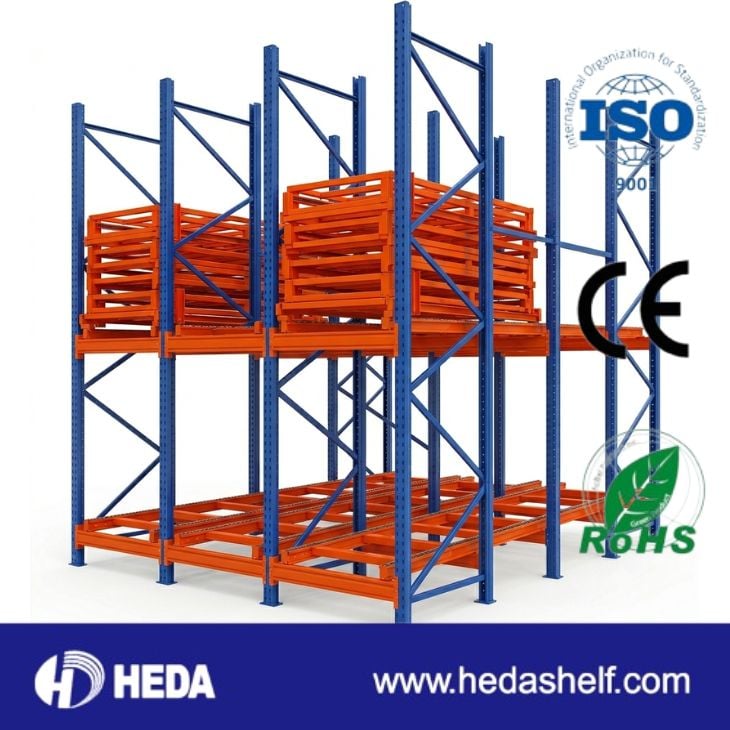
For high-volume warehouses managing high-density SKU batches, space efficiency cannot come at the expense of operational speed. HEDA Push Back Racking Systems combine the density of drive-in racking with the immediate selectivity of single-selective setups.
By utilizing a series of nested, heavy-duty rolling carts riding on inclined structural steel rails, our push back systems allow you to store pallets from 2 to 6 positions deep. When a front pallet is loaded, it gently pushes the preceding pallets back. When unloading, gravity smoothly brings the next pallet forward to the aisle face, ensuring a safe, efficient Last-In, First-Out (LIFO) workflow.
Note:Push-back racking strikes the exact balance between high-density cube utilization and operational speed.
75% Increase in Storage Capacity: By converting multiple access aisles into deep-lane storage lanes, you reclaim massive amounts of wasted floor space.
Enhanced Selectivity Over Drive-In Racking: Each lane can store a distinct SKU. Forklifts never need to enter the racking structure, significantly reducing truck cycle times and preventing costly upright damage.
Flawless Gravity-Fed Operation: Our custom-calculated rail inclination ensures that pallets glide forward smoothly without picking up unsafe speeds, protecting fragile inventory and operators.
Cold Storage Optimization: Maximize every cubic meter of expensive refrigerated or deep-freeze space. HEDA’s low-temperature powder coatings and specialized bearings perform flawlessly down to -30°C.
| Technical Parameter | Specification Details |
| Storage Density | 2-deep, 3-deep, 4-deep, 5-deep, and 6-deep configurations |
| Load Capacity | 500 kg to 1,500+ kg per pallet position (Customizable) |
| Material Composition | High-grade Q235B structural steel |
| Cart Design | Multi-tier nested carts with anti-derailment safety locks |
| Rail System | Precision-inclined steel tracks with impact-resistant entry guides |
| Surface Treatment | Premium electrostatic powder coating or hot-dip galvanized for cold storage |
| Compliance Standards | CE,ROHS and ISO9001 Certification |
HEDA Push Back Racking Systems are engineered for high-volume environments where maximizing pallet density and maintaining fast SKU selectivity are equally critical. If your facility manages medium-to-high volume batch inventory with a Last-In, First-Out (LIFO) rotation, this system is optimized for your workflow.
Cold Storage & Food Logistics: Maximizing every cubic meter of refrigerated or deep-freeze space is incredibly costly. HEDA push back systems allow you to pack frozen goods tightly together, reducing thermal loss while ensuring that different food batches retain dedicated lanes down to -30°C.
Third-Party Logistics (3PL) & E-Commerce Fulfillment: For hubs managing rapid turnarounds of high-volume SKUs, push back racking offers a massive advantage over drive-in systems. Because each lane can hold a distinct SKU, 3PL managers can store diverse client inventory side-by-side without digging through deep lanes.
Manufacturing Raw Materials & WIP Storing: Perfect for storing heavy manufacturing components, industrial steel components, packaging materials, or Work-In-Progress (WIP) goods. The high load capacity (up to 1,500+ kg) ensures heavy industrial pallets sit securely until called to the production floor.
Consumer Packaged Goods (CPG) Distribution: Ideal for high-density fast-moving consumer goods that are produced and shipped in medium-sized batches. This system eliminates unnecessary aisle space, keeping your highest-velocity products right at the pickup face for immediate loading dock access.
Pharmaceutical & Chemical Warehousing: Designed to handle secure, batched product runs where tracking by production lot or date code is required. Since forklift operators pick strictly from the aisle face, it reduces the risk of structural product damage or chemical contamination from forklift collisions inside the rack.
A: Push back racking systems are most commonly configured between 2-deep and 5-deep layouts. While 6-deep systems are technically possible, they require highly specialized forklift mast capacities and precise tilt control. For maximum operational speed and safety, a 3-deep or 4-deep configuration is typically the sweet spot for balance between density and forklift cycle efficiency.
A: While both are high-density, Last-In, First-Out (LIFO) storage setups, their operational workflows are completely different:
Drive-In Racking: Forklifts must drive directly inside the racking framework to deposit and retrieve pallets. This slows down cycle times and significantly increases the risk of structural upright damage.
Push Back Racking: Forklifts remain strictly in the operating aisle. Pallets sit on nested rolling carts that glide forward via gravity. This increases loading speeds by up to 50% and protects the rack structure from forklift collisions.
A: HEDA systems utilize a precision-engineered slope incline—typically between 3% and 4% grade depending on your maximum pallet weights. This inclination is calculated mathematically so that gravity can smoothly bring the next pallet forward to the picking face when the front pallet is removed, without generating unsafe speeds that could cause inventory shifting or impact damage.
A: Because the pallets sit on top of steel nested carts rather than riding directly on open rails, push back systems can accommodate minor variations in pallet width and depth. However, for safe operations, bottom boards must be structurally sound. Pallets with broken bottom runners or highly irregular configurations should not be used, as they can unbalance the nesting carts or catch on structural frames.
A: Every HEDA push back cart is engineered with integrated anti-derailment steel flanges and safety locks. These mechanical tabs hook directly beneath the structural steel channel rails. Even if a forklift operator lifts a pallet unevenly or makes an abrupt vertical adjustment, the cart cannot jump or lift off its track tracks.
A: Yes, they are highly effective in cold chain logistics where maximizing ambient air volume is critical. For temperatures down to -30°C, HEDA builds systems using high-yield Q355B structural steel, specialized low-temperature lubricants for the internal steel bearings, and specialized premium powder coatings (or hot-dip galvanizing) to prevent structural brittleness and metal binding.
A: Standard counterbalanced and reach trucks can operate push back systems seamlessly. However, the forklift mast must have a forward tilt capability matching the pitch of the rail system. This allows the operator to align the pallet parallel to the nested carts during insertion and extraction, ensuring smooth force distribution when pushing the rear pallets back.

 EN
EN